_______ Rock Can Be Changed Directly Into _______ Rock With the Application of Heat and Pressure.
Rocks are formed on Earth as igneous, sedimentary, or metamorphic rocks. Igneous rocks form when rocks are heated to the melting betoken which forms magma. Sedimentary rocks are formed from the cementing together of sediments, or from the compaction (squeezing together) of sediments, or from the recrystallization of new mineral grains which are larger than the original crystals. Metamorphic rocks form from heat and pressure level changing the original or parent rock into a completely new rock. The parent rock can be either sedimentary, igneous, or even another metamorphic rock. The discussion "metamorphic" comes from Greek and ways "To Change Grade".
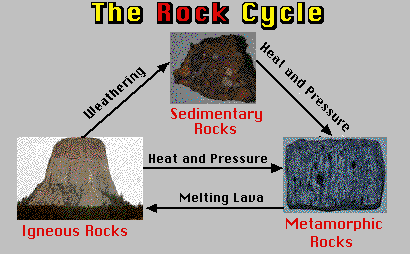
The diagram above shows you how the rocks on Earth accept been inverse continually over time from one rock blazon to some other. This irresolute of rock types is chosen the "Rock Bike".
Solid rock can be inverse into a new rock by stresses that cause an increase in oestrus and force per unit area. There are 3 main agents that cause metamorphism. Factors that crusade an increase in Temperature, Force per unit area, and Chemical changes are the three agents that we are going to study.
Temperature increases can exist caused by layers of sediments being buried deeper and deeper under the surface of the Earth. As we descend into the earth the temperature increases nigh 25 degrees Celsius for every kilometer that nosotros descend. The deeper the layers are buried the hotter the temperatures go. The corking weight of these layers also causes an increase in pressure, which in turn, causes an increase in temperature.
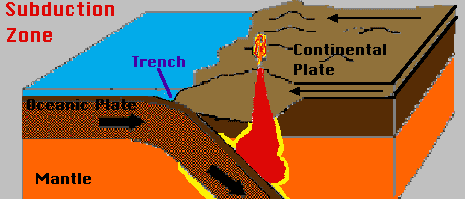
The descending of stone layers at subduction zones causes metamorphism in two ways; the shearing upshot of the plates sliding past each other causes the rocks coming in contact with the descending rocks to change. Some of the descending rock will melt considering of this friction. When stone melts it is so considered igneous not metamorphic, but the rock side by side to the melted stone tin can be inverse by the heat and become a metamorphic stone. The diagram above shows y'all where metamorphic rock (YELLOW ZONE) can be produced at a subduction zone.
There are 3 factors that crusade an increase in pressure which also causes the formation of metamorphic rocks. These factors are;
1.
The huge weight of overlying layers of sediments.
2.
Stresses caused past plates colliding in the process of mountain edifice.
iii.
Stresses caused by plates sliding past each other, such every bit the shearing stresses at the San Andreas fault zone in California.
Factors that cause chemical changes in rocks likewise contribute to the formation of metamorphic rocks. Very hot fluids and vapors can, because of farthermost pressures, fill up the pores of existing rocks. These fluids and vapors can crusade chemical reactions to take place, that over time, can change the chemical makeup of the parent rock.
Metamorphism can be instantaneous every bit in the shearing of rocks at plate boundaries or can have millions of years every bit in the tedious cooling of magma cached deep under the surface of the Globe.
There are 3 ways that metamorphic rocks tin form. The three types of metamorphism are Contact, Regional, and Dynamic metamorphism.
Contact Metamorphism occurs when magma comes in contact with an already existing body of rock. When this happens the existing rocks temperature rises and also becomes infiltrated with fluid from the magma. The area affected past the contact of magma is ordinarily small-scale, from 1 to 10 kilometers. Contact metamorphism produces non-foliated (rocks without any cleavage) rocks such equally marble, quartzite, and hornfels.
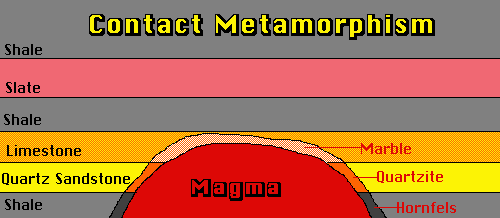
In the diagram above magma has pushed its way into layers of limestone, quartz sandstone and shale. The oestrus generated by the magma chamber has inverse these sedimentary rocks into the metamorphic rocks marble, quartzite, an hornfels.
Regional Metamorphism occurs over a much larger area. This metamorphism produces rocks such equally gneiss and schist. Regional metamorphism is caused past big geologic processes such as mountain-building. These rocks when exposed to the surface show the unbelievable pressure that crusade the rocks to be aptitude and broken past the mount building process. Regional metamorphism normally produces foliated rocks such equally gneiss and schist.
Dynamic Metamorphism likewise occurs because of mount-building. These huge forces of oestrus and pressure cause the rocks to exist bent, folded, crushed, flattened, and sheared.
Metamorphic rocks are almost ever harder than sedimentary rocks. They are generally as hard and sometimes harder than igneous rocks. They course the roots of many mountain chains and are exposed to the surface later the softer outer layers of rocks are eroded away. Many metamorphic rocks are found in mountainous regions today and are a proficient indicator that ancient mountains were present in areas that are now depression hill or even flat plains. Metamorphic rocks are divided into two categories- Foliates and Not-foliates.
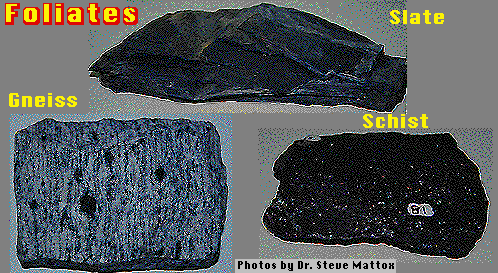
Foliates are composed of large amounts of micas and chlorites. These minerals have very distinct cleavage. Foliated metamorphic rocks will dissever along cleavage lines that are parallel to the minerals that make up the rock. Slate, equally an example, will split into thin sheets. Foliate comes from the Latin word that means sheets, as in the sheets of paper in a book.
Silt and clay can become deposited and compressed into the sedimentary rock shale. The layers of shale can go buried deeper and deeper by the procedure of deposition. Deposition is the laying down of rock forming material by any natural amanuensis (air current, water, glaciers) over time. Because these layers are buried, temperatures and pressures become greater and greater until the shale is inverse into slate. Slate is a fine-grained metamorphic rock with perfect cleavage that allows information technology to dissever into thin sheets. Slate usually has a light to dark brown streak. Slate is produced by depression grade metamorphism, which is acquired by relatively low temperatures and pressures.
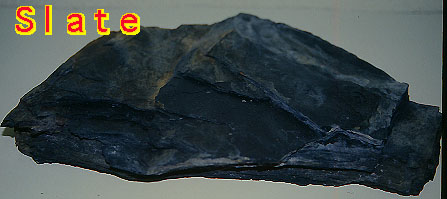
Slate has been used by man in a variety of ways over the years. One employ for slate was in the making of headstones or grave markers. Slate is not very difficult and can be carved easily. The problem with slate though is its perfect cleavage. The slate headstones would scissure and split along these cleavage planes as h2o would seep into the cracks and freeze which would lead to expansion. This freeze-thaw, freeze-thaw over time would divide the headstone. Today headstones are made of a variety of rocks, with granite and marble being two of the most widely used rocks. Slate was also used for chalk boards. The blackness color was skillful as a background and the rock cleaned hands with water. Today information technology is not very advantageous to use this rock because of its weight and the splitting and cracking over time.
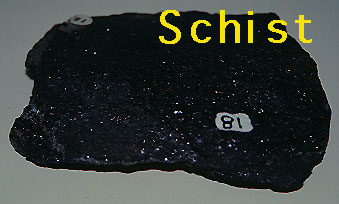
Schist is a medium grade metamorphic rock. This means that it has been subjected to more than rut and pressure than slate, which is a low grade metamorphic stone. As yous can see in the photo above schist is a more coarse grained rock. The private grains of minerals can be seen past the naked eye. Many of the original minerals have been altered into flakes. Considering information technology has been squeezed harder than slate it is often found folded and crumpled. Schists are usually named by the main minerals that they are formed from. Bitotite mica schist, hornblende schist, garnet mica schist, and talc schist are some examples of this.
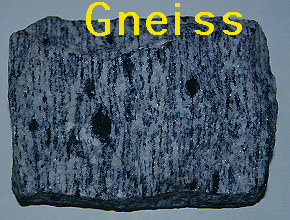
Gneiss is a high form metamorphic stone. This ways that gneiss has been subjected to more heat and pressure than schist. Gneiss is coarser than schist and has singled-out banding. This banding has alternating layers that are composed of different minerals. The minerals that etch gneiss are the same as granite. Feldspar is the most important mineral that makes up gneiss along with mica and quartz. Gneiss can be formed from a sedimentary rock such as sandstone or shale, or it can be formed from the metamorphism of the igneouse rock grantite. Gneiss tin can be used by man equally paving and building stone.
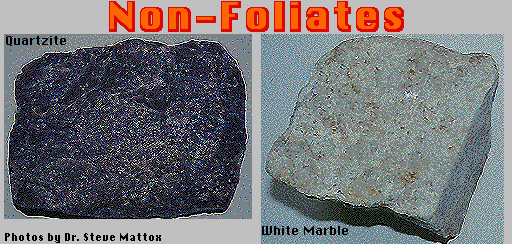
Non-Foliates are metamorphic rocks that have no cleavage at all. Quartzite and marble are two examples of non-foliates that nosotros are going to written report.
Quartzite is equanimous of sandstone that has been metamorphosed. Quartzite is much harder than the parent rock sandstone. It forms from sandstone that has come up into contact with deeply cached magmas. Quartzite looks similar to its parent rock. The best way to tell quartzite from sandstone is to break the rocks. Sandstone will shatter into many private grains of sand while quartzite will break across the grains.
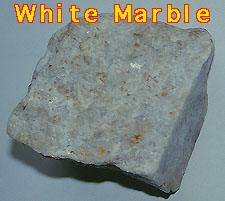
Marble is metamorphosed limestone or dolomite. Both limestone and dolomite have a large concentration of calcium carbonate (CaCO3). Marble has many dissimilar sizes of crystals. Marble has many color variances due to the impurities present at formation. Some of the unlike colors of marble are white, scarlet, black, mottled and banded, greyness, pink, and green.
Marble is much harder than its parent stone. This allows it to take a shine which makes it a practiced material for use as a edifice material, making sink tops, bathtubs, and a carving stone for artists. Today, headstones are made from marble and granite because both of these rocks atmospheric condition very slowly and carve well with sharp edges.
Marble is quarried in Vermont, Tennessee, Missouri, Georgia, and Alabama.
Write the answers to the following questions in complete sentences on a piece of paper.
1.
Write a definition in your own words of what a metamorphic rock is.
2.
What are the three agents of metamorphism?
3.
What are the three types of metamorphism?
4.
In your own words write a definition of the rock cycle.
Source: https://volcano.oregonstate.edu/metamorphic-rocks-lesson-14
0 Response to "_______ Rock Can Be Changed Directly Into _______ Rock With the Application of Heat and Pressure."
Post a Comment