Vanderbilt Family Homes Make America Great Again Hat

From the late 1870s to the 1920s, the Vanderbilt family employed some of the United states's best Beaux-Arts architects and decorators to build an incomparable cord of townhouses in New York City and Eastward Coast palaces in the United States. Many of the Vanderbilt houses are now National Historic Landmarks. Some photographs of Vanderbilt'southward residences in New York are included in the Photographic serial of American Compages by Albert Levy (1870s).
The list of architects employed by the Vanderbilts is a "who's who" of the New York-based firms that embodied the syncretic (frequently dismissed as "eclectic") styles of the American Renaissance: Richard Morris Hunt; George B. Mail service; McKim, Mead, and White; Charles B. Atwood; Carrère and Hastings; Warren and Wetmore; Horace Trumbauer; John Russell Pope and Addison Mizner were all employed by the descendants of Cornelius Vanderbilt, who congenital only very modestly himself.
Houses [edit]
- Cornelius Vanderbilt II (1843–1899)
- Townhouse, the "Cornelius Vanderbilt Two House" (1883) at 1 West 57th Street, Manhattan, New York past George B. Mail. Enlargements past George B. Mail and Richard Morris Hunt. This mansion remains the largest private residence ever congenital in Manhattan. Demolished.
- "The Breakers" in Newport, Rhode Island, in 1892–1895, which was also designed by Richard Morris Chase.[i]

- "Oakland Subcontract" (1893), mansion and stables on 150 acres in Portsmouth, Rhode Island. Demolished.
- Margaret Louisa Vanderbilt Shepard (1843–1927)
- Townhouse (1882), part of the Vanderbilt Triple Palace at two W 52nd Street, provided to them by her father and shared with her sister Emily Thorn Vanderbilt and their families. Demolished.
- Woodlea (1892–1895), a Stanford White–designed country estate in Scarborough, New York, now the Sleepy Hollow State Guild.
- William Kissam Vanderbilt (1849–1920) had three houses designed by Richard Morris Chase.
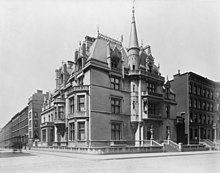
- "Petit Chateau", the New York City townhouse at 660 5th Artery, built in 1882 with details drawn in part from the late-Gothic Hôtel de Cluny, Paris. Proved an influential example for other Gilded Historic period mansions, but was demolished in 1926.
- "Idle Hour" land estate in Oakdale, Long Island, New York was built in 1878–79 and destroyed by fire in 1899. A new "Idle 60 minutes", designed by Hunt's son Richard Howland Hunt, was built on the same property from 1900–01 of brick and marble in the English Country Mode and is at present part of the Dowling College Campus.[two]
- "Marble Firm" summer dwelling house in Newport, Rhode Island, in 1888–1892.[3]
- "Château Vanderbilt", a Louis XIII fashion manor firm built in 1907 forth with three thoroughbred race tracks in Carrières-sous-Poissy, France. Designed by M. Henri Guillaume.
-
- Emily Thorn Vanderbilt (1852–1946), (Wife of William Douglas Sloane)
- Townhouse (1882), 642 Fifth Artery, part of the Vanderbilt Triple Palace, provided to them past her father. Demolished.
- "Elm Courtroom" in Lenox, Massachusetts, in 1887. Information technology is the largest shingle-way house in the U.s.a.. The 1919 "Elm Court Talks," held at Elm Court, led to the creation of The League of Nations and The Treaty of Versailles.
- Florence Adele Vanderbilt Twombly (Mrs. Hamilton Twombly) (1854–1952)
- Townhouse at 684 Fifth Avenue, New York (1883). Designed by John B. Snook, who as well designed her sister Lila Webb's townhouse side by side door. Demolished.[4]
- "Florham" in Convent Station, New Jersey, in 1894–1897. Designed by McKim, Mead and White as a summer manor, it is at present used for classrooms, faculty offices, and administration at Fairleigh Dickinson University [one]

- "Vinland" in Newport, Rhode Island. Renovated by Ogden Codman, Jr. Now role of the Salve Regina University
- Townhouse, her 2nd, a seventy-room house at i East 71st Street, New York. Designed past Whitney Warren. Demolished.
- Frederick William Vanderbilt (1856–1938)
- "Hyde Park" in Hyde Park, New York. Designed by McKim, Mead and White and built in 1896–1899, it is now the Vanderbilt Mansion National Historic Site.

- "Rough Signal" in Newport, Rhode Island designed past Peabody and Stearns congenital in 1892. [ii]
- "Pine Tree Point", Adirondack Great Camp on Upper St. Regis Lake in 1901
- "Sonogee" (1903) in Bar Harbor, Maine purchased and renovated in 1915.
-
- Eliza Osgood Vanderbilt Webb, a.g.a. Lila Vanderbilt Webb (1860–1936)
- "Shelburne Farms" in Shelburne, Vermont built in 1899.

- Townhouse (1883) at 680 Fifth Avenue, New York. The house was a wedding gift from William H. Vanderbilt to his daughter. Demolished.[4]
- "NaHaSaNe" (1893), the 115,000 acre Great Camp located on Lake Lila in the Adirondacks.
-
- George Washington Vanderbilt 2 (1862–1914),
- Townhouse (1887) at 9 West 53rd Street in New York Metropolis. Designed by Richard Morris Hunt. Demolished.
- "Biltmore" in Asheville, North Carolina, in 1888–1895. Designed by Chase, it is the largest firm in the United States [3]
- George Washington Vanderbilt Houses, 645 and 647 Fifth Avenue, New York, called the "Marble Twins". 1902–1905. Number 647 survives, a designated landmark, as the flagship store for Versace;[5] the site of 645 is now Olympic Tower.
- "Pointe d'Acadie" (1869), the Bar Harbor, Maine cottage purchased and renovated in 1889. Demolished 1952
- William Kissam Vanderbilt II (1878–1944)
- Townhouse at 666 Fifth Avenue (1905) designed by Stanford White, straight n of his parents' Petit Chateau. Demolished.
- "Deepdale" (1904), country estate in Smashing Neck, New York on Long Island. Designed by Horace Trumbauer and Carrère and Hastings.
- "Eagle's Nest", in 1910–1936, at Centerport, New York, designed by Warren and Wetmore.

- "Alva Base of operations" (1941), winter estate on Fisher Island, Florida[6]
- Consuelo Vanderbilt (1877–1964)
- "Casa Alva" (1934), winter residence on Palm Embankment, Florida. Designed by Maurice Fatio. Consuelo Vanderbilt sold the house in 1957.
- "Cara-Mia" (1900), residence in Southampton, New York
- "Sunderland Business firm" (1904), townhouse in London, England
- Harold Stirling Vanderbilt (1884–1970)
- "Rock Cliff" (1870), summertime residence in Newport, Rhode Island.
- "Eastover" (1930), winter residence in Manalapan, Florida. Designed by Maurice Fatio.
- Reginald Claypoole Vanderbilt (1880–1925)
- "Sandy Signal Farm" (1902), mansion and stables in Portsmouth, Rhode Isle. Reginald Claypoole Vanderbilt was very interested in horses and was involved in many different equestrian organizations.
- Townhouse (1896) at 12 Due east 77th Street in Manhattan, New York.
- Cornelius Vanderbilt 3 (1873–1942)
- Townhouse (1882)[seven] part of the Triple Palace at 640 Fifth Artery in Manhattan, New York. The house was completely renovated in 1914 by Grace Vanderbilt at a cost of $500,000. Demolished c. 1945.
- "Beaulieu" (1859), summer residence in Newport, Rhode Island. Bought by Vanderbilt in 1911.
- Alfred Gwynne Vanderbilt (1877–1915)
- "Sagamore Camp" (1897), smashing campsite in the Adirondack Mountains.

- "Oakland Farm" (remodeled and expanded 1901), Portsmouth, Rhode Island, colonial era home he transformed into a summertime home.
- "Vanderbilt Hotel" (1913), a hotel in Manhattan, New York on Park Artery and 34th Street. The penthouse served every bit a urban center residence for him.
-
- Gladys Vanderbilt Széchenyi (1886–1965) She was the married woman of Count László Széchenyi
- "Oermezo Castle" (1700), four,000 acre country estate in Zemplén Canton, Hungary.
- "Lagoshara Pusbla" four,300 acres, summer estate in Canton of Somogy, Hungary.
- Townhouse at 14 Eotvos Street in Budapest, Hungary.
- Gertrude Vanderbilt Whitney (1875–1942)
- "William C. Whitney Mansion" (1883) townhouse at 871 Fifth Artery in Manhattan, New York.
- "The Reef" (1885), summer residence in Newport, Rhode Island.
- "Applegreen" (1902), residence in Old Westbury, New York.
References [edit]
- ^ The Breakers: An Italian Renaissance Villa, The Preservation Society of Newport Canton
- ^ "Idle 60 minutes" Archived 2011-12-17 at the Wayback Machine
- ^ "Newport Mansions – The Preservation Club of Newport County". newportmansions.org.
- ^ a b File:5th avenue - 54th NY 1885 Albert Levy.jpg
- ^ Gray, Christopher. "Streetscapes: 647 5th Avenue; A Versace Restoration for a Vanderbilt Town Firm" New York Times (Apr ix, 1995) accessed 2 Dec 2008.
- ^ "History of Fisher Island – Fisher Island Gild & Resort, Miami Beach, Florida". fisherislandclub.com.
- ^ "The Gilded Age Era: The Last Vanderbilt Stronghold, 640 Fifth Avenue, the Home of MRS. Cornelius Vanderbilt". eighteen August 2012.
External links [edit]
- The Vanderbilt houses
Source: https://en.wikipedia.org/wiki/Vanderbilt_houses
0 Response to "Vanderbilt Family Homes Make America Great Again Hat"
Post a Comment