with regard to sound what is the crucial difference between sound and silent films
Filming Modern Times

Modern Times marked the terminal screen appearance of the Piffling Tramp - the character which had brought Charles Chaplin world fame, and who still remains the most universally recognised fictional prototype of a human beingness in the history of art.
The earth from which the Tramp took his farewell was very different from that into which he had been born, two decades before, before the Start World State of war. Then he had shared and symbolised the hardships of all the underprivileged of a world only only emerging from the 19th century. Modern Times found him facing very different predicaments in the aftermath of America's Dandy Depression, when mass unemployment coincided with the massive rise of industrial automation.

Chaplin was acutely preoccupied with the social and economical problems of this new age. In 1931 and 1932 he had left Hollywood behind, to embark on an xviii-month world tour. In Europe, he had been disturbed to come across the rise of nationalism and the social furnishings of the Depression, of unemployment and of automation. He read books on economic theory; and devised his ain Economical Solution, an intelligent exercise in utopian idealism, based on a more equitable distribution not just of wealth but of work. In 1931 he told a newspaper interviewer :
"Unemployment is the vital question . . . Machinery should do good mankind. It should non spell tragedy and throw it out of piece of work."
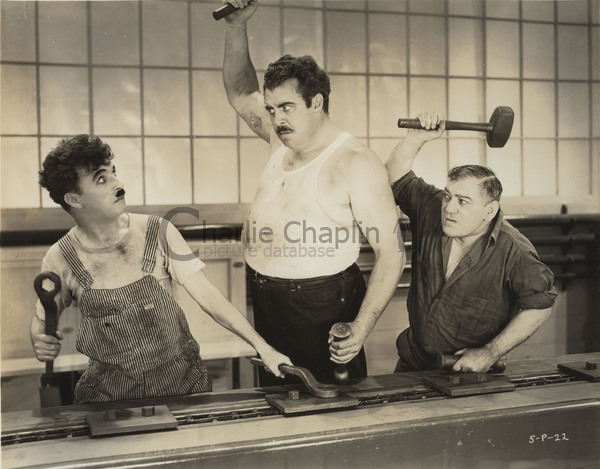
In Modern Times he set out to transform his observations and anxieties into comedy. The piddling Tramp - described in the film credits as "a Factory Worker"- is now one of the millions coping with the problems of the 1930s, which are not so very different from anxieties of the 21st century - poverty, unemployment, strikes and strike breakers, political intolerance, economic inequalities, the tyranny of the machine, narcotics. The pic'south portentous opening championship - "The story of industry, of individual enterprise - humanity crusading in the pursuit of happiness" - is followed by a symbolic juxtaposition of shots of sheep being herded and of workers streaming out of a factory. Chaplin's graphic symbol is first seen as a worker existence driven crazy past his monotonous, inhuman work on a conveyor belt and being used every bit a guinea pig to test a machine to feed workers as they work.
Paulette Goddard

Exceptionally, the Tramp has a companion in his battle with this new world. On his return to America later on a world tour in 1931, Chaplin had met the extra Paulette Goddard, who was to remain, for several years, an ideal partner in his individual life. Her personality inspired the character of the "Gamine" in Modern Times - a young daughter whose father has been killed in a labour demonstration, and who joins forces with Chaplin. The couple are neither rebels nor victims, just, wrote Chaplin, "The only two live spirits in a world of automatons. We are children with no sense of responsibility, whereas the rest of humanity is weighed down with duty. We are spiritually free". In a sense, and so, they are anarchists.

Chaplin at offset planned a sadly sentimental ending for the film. While the Tramp was in hospital, recovering from nervous break-downwardly, the Gamine was to become a Nun so be parted from him for always. This ending was filmed, but was finally abased in favour of a more cheerful finale. "Nosotros'll get along", says a title; and the couple, arm in arm, set up bravely off downwardly a land lane, towards the horizon

By the fourth dimension Modernistic Times was released, talking pictures had been established for nearly a decade. Till at present, Chaplin had resisted dialogue, knowing that his comedy and its universal agreement depended on silent pantomime. This time though he weakened to the extent of preparing dialogue, and even doing some trial recordings. Finally he thought improve of information technology, and equally in Urban center Lights uses but music and sound furnishings. Human voices are only heard filtered through technological devices - the dominate who addresses his workers from a television screen; the salesman who is but a voice on the phonograph.
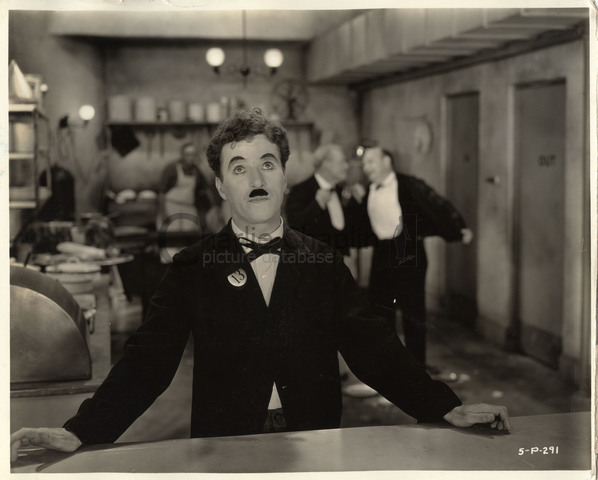
Merely at 1 moment, though, Chaplin'southward own voice is heard straight. Hired as a waiter, the Little Worker is required to stand up in for the romantic café tenor. He writes the words on his shirt cuffs, but these wing off with a too-dramatic flourish; and he is obliged to improvise the song in a wonderful, mock-Italian gibberish. Chaplin's vocalisation had already been heard on radio and in at least one newsreel, but this was the first and only time that the world heard speech from the Little Tramp.
Apart from this indecision over sound and the changed ending, the shooting seems to take been fairly untroubled and, by Chaplin'southward standards, insufficiently fast. It may have helped that the essential construction is neatly devised in four "acts" each one more or less equivalent to one of his old ii-reel comedies. Every bit the gimmicky American critic Otis Ferguson wrote, they might have been individually titled The Shop, The Jailbird, The Watchman and The Singing Waiter.

As he had done for Metropolis Lights Chaplin composed his ain musical score, giving his arrangers and conductors a harder time than usual, with the event that the distinguished Hollywood musician Alfred Newman walked off the picture.
The pic became the victim of a foreign charge of plagiarism. The Franco-High german firm of Tobis claimed that Chaplin had stolen ideas and scenes from another archetype moving picture virtually the 20th century industrial world, A Nous la Liberté, directed by René Clair. The case was weak, and Clair, a cracking admirer of Chaplin, was securely embarrassed by information technology. However Tobis persisted, and fifty-fifty renewed its claims in May 1947, after the 2nd Earth State of war. This time the Chaplin Studio finally agreed to a modest payment, only to go rid of the nuisance. Chaplin and his lawyers remained convinced that the determination of the German-dominated company was revenge for the anti-Nazi sentiment of The Great Dictator.
Happily for posterity, Tobis failed in their original demand to have Chaplin¹s film permanently suppressed. Instead, Modern Times survives as a commentary on human survival in the industrial, economical and social circumstances of the 20th century club. It remains as relevant, in human terms, for the 21st century.
The Challenge of Sound
The inflow of sound films was a bigger claiming for Chaplin than for any other actor or director. He had won globe fame with the universal linguistic communication of pantomime. If the Piddling Tramp at present began to speak in English he would get incomprehensible to a large role of his international audience. In 1931 he predicted that talking pictures would not last six months, and told an interviewer that 'Dialogue may or may not take a place in one-act . . . dialogue does non take a place in the sort of comedies I make . .. For myself I know that I cannot employ dialogue.' When the interviewer asked him if he had tried using speech in his films, he retorted "I never tried jumping off the monument in Trafalgar Square, but I have a definite idea that it would be unhealthful. . . For years I have specialized in i type of comedy - strictly pantomime. I have measured information technology, gauged information technology, studied. I take been able to establish exact principles to govern its reactions on audiences. It has a certain stride and tempo. Dialogue, to my way of thinking, e'er slows activity, considering action must wait upon words."

By the fourth dimension he came to set up Mod Times however, it seemed that he had steeled himself to use speech. In the Chaplin archives in that location is a dialogue script for all scenes in Modern Times upwards to and including the department store sequence. The dialogue which Chaplin planned for his own character is staccato, quippy, touched with nonsense. He began to rehearse the dialogue for the scenes in the jail and warden'due south office; only after only a day or and then seems to have been deeply dissatisfied with the results. No more dialogue scenes were to be shot for Modern Times.
Chaplin did go on with sound effects, however, and took a personal interest in the technique of their creation. For a scene involving rumbling stomachs, he created the noises himself by bravado bubbling into a pail of water. The fact that Chaplin was sufficiently nifty to create the effects himself in this way suggests the extent to which he was intrigued by sound issues at this fourth dimension. A memorandum near possible musical effects notes: 'Natural sounds role of limerick, i.e. Auto horns, sirens, and cowbells worked into the music.' The sound effects became an element of the musical score.
The Premieres
Modern Times was launched more quietly than previous Chaplin films. The picture show opened in New York on 5 February 1936, and in London on xi February. Chaplin and his co-star Paulette Goddard attended a tertiary and the most glamorous "premiére" in Hollywood on 12 February. The venue was Grauman's Chinese Theatre, which had opened in 1927 as "a shrine to art … the crowning accomplishment of a bright career … the realization of the vision of a simple soul, a master showman … Sid Grauman". The guests were handed programmes designed in lush and glamorous Art Deco fashion, printed in blackness and crimson on gilded paper.

In the by Grauman had devised elaborate live stage shows for Chaplin premieres, merely this time the entertainment was entirely on screen, with a newsreel, a travelogue, a Technicolor interest film, and the latest issue of the current documentary series The March of Fourth dimension - though, emphasising its topicality, this was announced as "Subject field to weather conditions for Air Express".
The most notable item in the supporting plan was a new Dizzy Symphony from the Walt Disney Studios, Mickey's Orphan Concert. The inclusion of this cartoon exemplified an intense mutual adoration betwixt Chaplin and Disney, who both recognised similarities in the other's piece of work. Disney bought ad space in the plan, "In appreciation of the pantomimist supreme whose inimitable artistry and craftsmanship are timeless". It was signed, "Mickey Mouse and Walt Disney".

Text by David Robinson © 2004 MK2 SA
Source: https://www.charliechaplin.com/en/articles/6-Filming-Modern-Times
0 Response to "with regard to sound what is the crucial difference between sound and silent films"
Post a Comment