The Best Nws Media House in South Africa Now
 | |
| Bureau overview | |
|---|---|
| Formed | February nine, 1870 (1870-02-09) |
| Preceding agency |
|
| Jurisdiction | United States federal government |
| Headquarters | Argent Spring, Maryland 38°59′thirty″N 77°01′48″W / 38.99167°Due north 77.03000°W / 38.99167; -77.03000 Coordinates: 38°59′30″N 77°01′48″West / 38.99167°N 77.03000°Westward / 38.99167; -77.03000 |
| Almanac budget | US$1.204 billion (FY 2021) |
| Agency executive |
|
| Parent agency | National Oceanic and Atmospheric Assistants |
| Child agency |
|
| Key document |
|
| Website | weather.gov |
| Footnotes | |
| [i] [two] [iii] [4] | |
The National Weather condition Service (NWS) is an bureau of the United States federal government that is tasked with providing atmospheric condition forecasts, warnings of hazardous conditions, and other weather-related products to organizations and the public for the purposes of protection, safety, and general information. It is a part of the National Oceanic and Atmospheric Administration (NOAA) branch of the Department of Commerce, and is headquartered in Silver Spring, Maryland, within the Washington metropolitan area.[5] [6] The agency was known as the The states Weather Bureau from 1890 until information technology adopted its electric current name in 1970.[7]
The NWS performs its primary job through a drove of national and regional centers, and 122 local Weather Forecast Offices (WFOs). As the NWS is an agency of the U.S. federal authorities, most of its products are in the public domain and available free of charge.
History [edit]
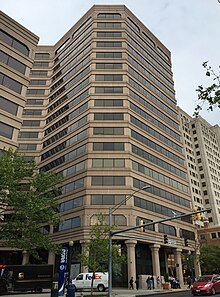
NWS HQ in Silver Spring, Maryland
In 1870, the Weather Bureau of the United States was established through a articulation resolution of Congress signed by President Ulysses S. Grant[8] with a mission to "provide for taking meteorological observations at the military stations in the interior of the continent and at other points in the states and Territories... and for giving detect on the northern (Bang-up) Lakes and on the seacoast by magnetic telegraph and marine signals, of the approach and force of storms." The agency was placed under the Secretary of War as Congress felt "military subject would probably secure the greatest promptness, regularity, and accurateness in the required observations." Within the Department of State of war, it was assigned to the U.South. Army Signal Service nether Brigadier General Albert J. Myer. Full general Myer gave the National Weather Service its first name: The Segmentation of Telegrams and Reports for the Benefit of Commerce.[9]
Cleveland Abbe – who began developing probabilistic forecasts using daily weather information sent by the Cincinnati Chamber of Commerce and Western Union, which he convinced to dorsum the collection of such information in 1869 – was appointed as the Agency's first master meteorologist. In his earlier office as the civilian assistant to the chief of the Signal Service, Abbe urged the Department of War to research weather atmospheric condition to provide a scientific basis behind the forecasts; he would go on to urge the written report of meteorology as a science after condign Conditions Bureau main. While a argue went on between the Point Service and Congress over whether the forecasting of weather atmospheric condition should be handled past civilian agencies or the Signal Service's existing forecast part, a Congressional commission was formed to oversee the matter, recommending that the office'due south operations be transferred to the Department of War following a two-yr investigation.[10]
The bureau first became a noncombatant enterprise in 1890, when it became office of the Department of Agriculture. Under the oversight of that branch, the Agency began issuing flood warnings and burn down weather forecasts, and issued the first daily national surface weather maps; it also established a network to distribute warnings for tropical cyclones as well as a data substitution service that relayed European weather condition assay to the Bureau and vice versa.[11] The first Weather Bureau radiosonde was launched in Massachusetts in 1937, which prompted a switch from routine aircraft observation to radiosondes inside ii years. The Agency prohibited the word "tornado" from being used in any of its weather condition products out of concern for inciting panic (a motility contradicted in its intentions by the loftier death tolls in past tornado outbreaks due to the lack of avant-garde alert) until 1938, when it began disseminating tornado warnings exclusively to emergency management personnel.[12]
The Bureau would later be moved to the Department of Commerce in 1940.[13] On July 12, 1950, Bureau chief Francis W. Reichelderfer officially lifted the bureau'south ban on public tornado alerts in a Circular Letter, noting to all showtime club stations that "Weather Agency employees should avoid statements that tin be interpreted as a negation of the Bureau's willingness or ability to make tornado forecasts", and that a "good probability of verification" exist when issuing such forecasts due to the difficulty in accurately predicting tornadic activity.[fourteen] However, it would not exist until information technology faced criticism for standing to reject to provide public tornado warnings and preventing the release of the USAF Severe Weather Alarm Center's tornado forecasts (pioneered in 1948 past Air Strength Capt. Robert C. Miller and Major Ernest Fawbush) beyond military personnel that the Bureau issued its first experimental public tornado forecasts in March 1952.[12] In 1957, the Bureau began using radars for short-term forecasting of local storms and hydrological events, using modified versions of those used by Navy shipping to create the WSR-57 (Westeather Due southurveillance Radar, 1957), with a network of WSR systems being deployed nationwide through the early 1960s;[15] some of the radars were upgraded to WSR-74 models beginning in 1974.[ citation needed ]
The Weather Bureau became function of the Environmental Science Services Administration when that agency was formed in Baronial 1966. The Environmental Scientific discipline Services Administration was renamed the National Oceanic and Atmospheric Administration (NOAA) on October one, 1970, with the enactment of the National Environmental Policy Act. At this time, the Weather Bureau became the National Weather Service.[8] NEXRAD (Next Generation Radar), a system of Doppler radars deployed to improve the detection and warning time of severe local storms, replaced the WSR-57 and WSR-74 systems between 1988 and 1997.[sixteen] [17]
Forecast sub-organizations [edit]
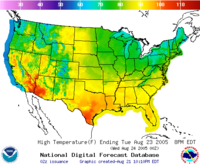
Sample maximum temperature map from the NDFD.
The NWS, through a variety of sub-organizations, issues different forecasts to users, including the general public. Although, throughout history, text forecasts take been the ways of product dissemination, the NWS has been using more than forecast products of a digital, gridded, image or other modern format.[eighteen] Each of the 122 Conditions Forecast Offices (WFOs) transport their graphical forecasts to a national server to exist compiled in the National Digital Forecast Database (NDFD).[19] The NDFD is a drove of common weather observations used by organizations and the public, including precipitation amount, temperature, and deject cover amongst other parameters. In addition to viewing gridded weather condition data via the internet, users can download and utilize the individual grids using a "GRIB2 decoder" which tin can output information equally shapefiles, netCDF, GrADS, float files, and comma separated variable files.[20] Specific points in the digital database can be accessed using an XML SOAP service.
Fire weather [edit]
The National Weather Service issues many products relating to wildfires daily. For example, a Fire Weather Forecast, which take a forecast menses covering up to seven days, is issued by local WFOs daily, with updates as needed. The forecasts incorporate weather information relevant to fire control and fume direction for the next 12 to 48 hours, such as wind direction and speed, and atmospheric precipitation. The appropriate crews apply this information to programme for staffing and equipment levels, the ability to behave scheduled controlled burns, and appraise the daily fire danger. Once per day, NWS meteorologists event a coded fire weather forecast for specific United States Wood Service observation sites that are and so input into the National Fire Danger Rating System (NFDRS). This computer model outputs the daily fire danger that is then conveyed to the public in one of five ratings: low, moderate, high, very high, or extreme.[21]
The local Weather Forecast Offices of the NWS also, under a prescribed ready of criteria, issue Fire Weather condition Watches and Red Flag Warnings as needed, in addition to issuing the daily fire weather forecasts for the local service area. These products alert the public and other agencies to conditions which create the potential for extreme fires. On the national level, the NWS Storm Prediction Center issues fire weather analyses for days one and two of the forecast period that provide supportive information to the local WFO forecasts regarding item disquisitional elements of fire weather atmospheric condition. These include large-scale areas that may experience critical fire conditions weather condition including the occurrence of "dry out thunderstorms," which ordinarily occur in the western U.S., and are non accompanied by any pelting due to it evaporating before reaching the surface.[22]
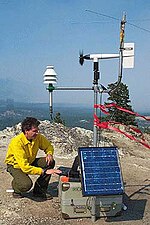
NWS IMET Chris Gibson taking observations in the field.
State and federal forestry officials sometimes request a forecast from a WFO for a specific location called a "spot forecast," which are used to determine whether it will be safe to ignite a prescribed burn down and how to situate crews during the decision-making phase. Officials send in a request, usually during the early on forenoon, containing the position coordinates of the proposed burn, the ignition fourth dimension, and other pertinent information. The WFO composes a short-term fire weather forecast for the location and sends it back to the officials, usually within an hour of receiving the request.[22]
The NWS assists officials at the scene of big wildfires or other disasters, including HAZMAT incidents, by providing on-site support through Incident Meteorologists (IMET).[23] IMETs are NWS forecasters specially trained to work with Incident Management Teams during severe wildfire outbreaks or other disasters requiring on-site atmospheric condition support. IMETs travel quickly to the incident site and then gather a mobile weather center capable of providing continuous meteorological support for the elapsing of the incident. The kit includes a cell telephone, a laptop figurer, and communications equipment, used for gathering and displaying weather information such every bit satellite imagery or numerical forecast model output. Remote weather stations are too used to gather specific information for the point of interest,[23] and often receive directly support from the local WFO during such crises. IMETs, approximately 70 to 80 of which are employed nationally, can be deployed anywhere a disaster strikes and must be capable of working long hours for weeks at a fourth dimension in remote locations under rough weather.[ citation needed ]
Weather Forecast Offices [edit]
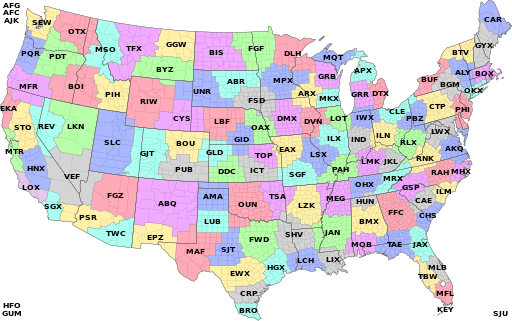
The National Conditions Service uses local branches, known as Weather Forecast Offices (WFOs), to issue products specific to those areas. Each WFO maintains a specific area of responsibleness spanning multiple counties, parishes or other jurisdictions within the Continental United states – which, in some areas, comprehend multiple states – or individual possessions; the local offices handle responsibility of composing and disseminating forecasts and weather alerts to areas inside their region of service. Some of the products that are only issued by the WFOs are severe thunderstorm and tornado warnings, overflowing, flash flood, and winter weather watches and warnings, some aviation products, and local forecast grids. The forecasts issued by a WFO are available on their individual pages within the Weather.gov website, which tin be accessed through either forecast landing pages (which identify the office that disseminates the atmospheric condition data) or via the warning map featured on the main page of the National Weather condition Service website.
National Centers for Environmental Prediction [edit]
Aviation [edit]
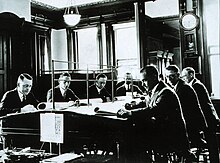
Meteorologists preparing a forecast, early 20th century.
The NWS supports the aviation community through the production of several forecasts. Each area'south WFO has responsibility for the issuance of Final Aerodrome Forecasts (TAFs) for airports in their jurisdiction.[24] TAFs are concise, coded 24-hour forecasts (30-hour forecasts for certain airports) for a specific airdrome, which are issued every half dozen hours with amendments as needed. As opposed to a public weather forecast, a TAF merely addresses weather elements critical to aviation; these include current of air, visibility, deject cover and wind shear.
Twenty-one NWS Eye Weather Service Units (CWSU) are collocated with the Federal Aviation Administration (FAA) Air Route Traffic Control Centers (ARTCC). Their main responsibleness is to provide up-to-the-minute conditions information and briefings to the Traffic Direction Units and command room supervisors. Special emphasis is given to weather weather that could be chancy to aviation or impede the flow of air traffic in the National Airspace Organisation. Besides scheduled and unscheduled briefings for conclusion-makers in the ARTCC and other FAA facilities, CWSU meteorologists likewise issue two unscheduled products. The Center Conditions Advisory (CWA) is an aviation conditions alarm for thunderstorms, icing, turbulence, and depression cloud ceilings and visibilities. The Meteorological Impact Statement (MIS) is a 2- to 12-60 minutes forecast that outlines weather condition conditions expected to affect ARTCC operations.[25]
The Aviation Atmospheric condition Center (AWC), located in Kansas City, Missouri, is a central aviation back up facility operated by the National Weather Service, which issues 2 primary products:
- AIRMET (Airmen's Meteorological Information) – Information on icing, turbulence, mount obscuration, depression-level wind shear, instrument meteorological atmospheric condition, and strong surface winds.
- SIGMETs (Pregnant Meteorological Information) – Issued for significant weather that may bear on an aerodrome of flying path in an area:
- Convective – Issued for an surface area of thunderstorms affecting an area of iii,000 square miles (7,800 km2) or greater, a line of thunderstorms at least 60 nmi (110 km) long, or severe or embedded thunderstorms affecting whatever area that are expected to terminal 30 minutes or longer.
- Non-convective – Issued for severe turbulence over a 3,000 square miles (seven,800 km2) area, severe icing over a 3,000 square miles (7,800 kmtwo), or instrument meteorological weather condition over a iii,000 foursquare miles (seven,800 km2) area due to dust, sand, or volcanic ash.
Storm Prediction Center [edit]
The Tempest Prediction Center (SPC) in Norman, Oklahoma issues astringent thunderstorm and tornado watches in cooperation with local WFOs which are responsible for delineating jurisdictions affected past the issued watch, and SPC too problems mesoscale discussions focused upon possible convective activity. SPC compiles reports of severe hail, current of air, or tornadoes issued by local WFOs each day when thunderstorms producing such phenomena occur in a given area, and formats the data into text and graphical products. It likewise provides forecasts on convective activity through day eight of the forecast menstruation (most prominently, the threat of severe thunderstorms, the risk of which is assessed through a tiered arrangement conveyed amid 6 categories – general thunderstorms, marginal, slight, enhanced, moderate, or high – based mainly on the expected number of storm reports and regional coverage of thunderstorm activity over a given forecast 24-hour interval), and is responsible for issuing burn down weather condition outlooks, which support local WFOs in the decision of the need for Cerise Flag Warnings.
Atmospheric condition Prediction Center [edit]
The Weather condition Prediction Centre in College Park, Maryland provides guidance for future precipitation amounts and areas where excessive rainfall is likely,[26] while local NWS offices are responsible for issuing Overflowing Watches, Wink Flood Watches, Flood Warnings, Flash Flood Warnings, and Flood Advisories for their local County Warning Expanse, as well as the official rainfall forecast for areas within their warning area of responsibility. These products can and practice emphasize different hydrologic problems depending on geographic area, state utilize, time of year, likewise as other meteorological and non-meteorological factors (for case, during the early spring or late winter a Flood Warning can be issued for an ice jam that occurs on a river, while in the summer a Alluvion Warning will most probable exist issued for excessive rainfall).
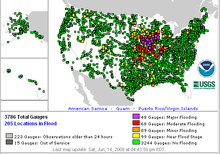
In recent years, the NWS has enhanced its broadcasting of hydrologic information through the Avant-garde Hydrologic Prediction Service (AHPS).[27] The AHPS allows anyone to view near real-time observation and forecast information for rivers, lakes and streams. The service also enables the NWS to provide long-range probabilistic information which tin can be used for long-range planning decisions.
River Forecast Centers [edit]
Daily river forecasts are issued past the thirteen River Forecast Centers (RFCs) using hydrologic models based on rainfall, soil characteristics, precipitation forecasts, and several other variables. The first such middle was founded on September 23, 1946.[28] Some RFCs, especially those in mountainous regions, also provide seasonal snow pack and peak catamenia forecasts. These forecasts are used by a wide range of users, including those in agronomics, hydroelectric dam operation, and water supply resources.
Body of water Prediction Center [edit]
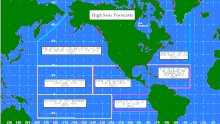
The National Conditions Service areas of marine weather forecasting responsibleness.
The National Weather Service Body of water Prediction Center (OPC) in College Park, Maryland[29] issues marine products for areas that are within the national waters of the United states. NWS national centers or Conditions Forecast Offices issue several marine products:
- Coastal Waters Forecast (CWF) – a text production issued by all coastal WFOs to explicitly land expected conditions conditions within their marine forecast area of responsibility through day five; it also addresses expected wave heights.
- Offshore Waters Forecast (OFF) – a text product issued by the OPC that provides forecast and alert information to mariners who travel on the oceanic waters adjacent to the U.S. coastal waters through day v.
- NAVTEX forecast – a text forecast issued by the OPC (combining information from the Littoral Waters and Offshore Waters Forecasts) designed to accommodate broadcast restrictions of U.S. Coast Guard NAVTEX transmitters.
- High Seas Forecast (HSF) – routine text product issued every 6 hours past OPC to provide alert and forecast information to mariners who travel on the oceanic waters.
National Hurricane Center [edit]
The National Hurricane Center (NHC) and the Central Pacific Hurricane Center (CPHC), respectively based in Miami, Florida and Honolulu, Hawaii, are responsible for monitoring tropical weather in the Atlantic, and key and eastern Pacific Oceans. In addition to releasing routine outlooks and discussions, the guidance heart initiates advisories and discussions on private tropical cyclones, as needed. If a tropical whirlwind threatens the United States or its territories, private WFOs brainstorm issuing statements detailing the expected effects within their local area of responsibility. The NHC and CPHC issue products including tropical whirlwind advisories, forecasts, and formation predictions, and warnings for the areas in the Atlantic and parts of the Pacific.

Sample CPC 3.v-month temperature outlook.
Climate Prediction Middle [edit]
The Climate Prediction Center (CPC) in College Park, Maryland is responsible for all of the NWS's climate-related forecasts. Their mission is to "serve the public by assessing and forecasting the impacts of short-term climate variability, emphasizing enhanced risks of conditions-related farthermost events, for apply in mitigating losses and maximizing economic gains." Their products cover time scales from a week to seasons, extending into the future as far equally technically feasible, and cover the land, the ocean and the atmosphere, extending into the stratosphere. Well-nigh of the products issued by the center cover the Face-to-face U.South. and Alaska.
Additionally, Weather Forecast Offices event daily and monthly climate reports for official climate stations within their surface area of responsibility. These generally include recorded highs, lows and other information (including historical temperature extremes, fifty-twelvemonth temperature and precipitation averages, and degree days). This information is considered preliminary until certified by the National Climatic Data Middle.
Data acquisition [edit]
Surface observations [edit]
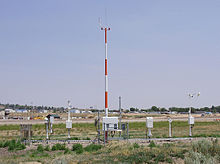
An Automated Surface Observing System (ASOS).
The primary network of surface weather observation stations in the The states is composed of Automatic Surface Observing Systems (ASOS). The ASOS program is a articulation effort of the National Atmospheric condition Service (NWS), automatic conditions station(AWS)[30], the Federal Aviation Administration (FAA), and the Department of Defense (DOD).[31] ASOS stations are designed to back up weather forecast activities and aviation operations and, at the aforementioned time, support the needs of the meteorological, hydrological, and climatological research communities. ASOS was especially designed for the prophylactic of the aviation community, therefore the sites are near ever located near aerodrome runways. The system transmits routine hourly observations along with special observations when atmospheric condition exceed aviation conditions thresholds (east.g. weather condition alter from visual meteorological weather to instrument meteorological conditions). The basic weather elements observed are: sky condition, visibility, nowadays weather, obstructions to vision, pressure, temperature, dew bespeak, current of air direction and speed, atmospheric precipitation accumulation, and selected meaning remarks. The coded observations are issued every bit METARs and expect like to this:
METAR KNXX 121155Z 03018G29KT i/4SM +TSSN FG VV002 M05/M07 A2957 RMK PK WND 01029/1143 SLP026 SNINCR 2/ten RCRNR T2 SET 6///// vii//// 4/010 T10561067 11022 21056 55001 PWINO PNO FZRANO
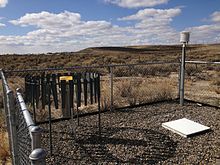
A Cooperative Observer Program weather station.
Getting more data on the temper, more frequently, and from more locations is the key to improving forecasts and warnings. Due to the big installation and operating costs associated with ASOS, the stations are widely spaced. Therefore, the Cooperative Observer Program (COOP), a network of approximately 11,000 mostly volunteer weather observers, provides much of the meteorological and climatological data to the land. The program, which was established in 1890 nether the Organic Act, currently has a twofold mission:
- Provide observational meteorological information, commonly consisting of daily maximum and minimum temperatures, snow, and 24-hour precipitation totals, required to ascertain the climate of the United States and to help measure out long-term climate changes.
- Provide observational meteorological data in about real-time to back up forecast, alert and other public service programs of the NWS.
The National Weather Service also maintains connections with privately operated mesonets such as the Citizen Atmospheric condition Observer Program for data collection, in part, through the Meteorological Assimilated Data Ingest System (MADIS). Funding is also provided to the CoCoRaHS volunteer weather condition observer network through parent agency NOAA.
Marine observations [edit]

three-metre (9.8 ft) discus beacon located off the Southeast U.South. coast.
NWS forecasters need frequent, high-quality marine observations to examine conditions for forecast training and to verify their forecasts after they are produced. These observations are especially disquisitional to the output of numerical weather models considering large bodies of h2o have a profound impact on the weather. Other users rely on the observations and forecasts for commercial and recreational activities. To help come across these needs, the NWS'due south National Data Buoy Centre (NDBC) in Hancock Canton, Mississippi operates a network of about 90 buoys and lx land-based coastal observing systems (C-MAN). The stations measure wind speed, management, and gust; barometric pressure; and air temperature. In addition, all buoy and some C-Human being stations measure out sea surface temperature, and wave height and period.[32] Conductivity and h2o current are measured at selected stations. All stations report on an hourly basis.
Supplemental weather observations are acquired through the United States Voluntary Observing Send (VOS) program.[33] It is organized for the purpose of obtaining weather and oceanographic observations from transiting ships. An international programme under World Meteorological System (WMO) marine auspices, the VOS has 49 countries every bit participants. The United States program is the largest in the world, with about 1,000 vessels. Observations are taken by deck officers, coded in a special format known every bit the "ships synoptic code", and transmitted in real-time to the NWS. They are and then distributed on national and international circuits for apply past meteorologists in conditions forecasting, by oceanographers, ship routing services, fishermen, and many others. The observations are and so forwarded for use by the National Climatic Data Center (NCDC) in Asheville, N Carolina.
Upper air observations [edit]

A radiosonde before long after launch.
Upper air atmospheric condition data is essential for weather forecasting and research. The NWS operates 92 radiosonde locations in N America and ten sites in the Caribbean area. A pocket-size, expendable instrument package is suspended beneath a two metres (vi.half dozen ft) wide airship filled with hydrogen or helium, then released daily at or presently after 1100 and 2300 UTC, respectively. As the radiosonde rises at about 300 meters/minute (1,000 ft/min), sensors on the radiosonde measure profiles of pressure level, temperature, and relative humidity. These sensors are linked to a battery-powered radio transmitter that sends the sensor measurements to a basis receiver. Past tracking the position of the radiosonde in flying, information on air current speed and management aloft is likewise obtained. The flying tin can last longer than two hours, and during this time the radiosonde tin ascend above 35 km (115,000 ft) and drift more than 200 km (120 mi) from the release indicate. When the balloon has expanded across its elastic limit and bursts (about 6 grand or 20 ft in bore), a small parachute slows the descent of the radiosonde, minimizing the danger to lives and property. Data obtained during the flights is coded and disseminated, at which point information technology can be plotted on a Skew-T or Stuve diagram for analysis. In contempo years, the National Atmospheric condition Service has begun incorporating data from AMDAR in its numerical models (notwithstanding, the raw data is not available to the public).
Event-driven products [edit]
The National Atmospheric condition Service has adult a multi-tier concept for forecasting or alerting the public to all types of chancy conditions:
- Outlook – Chancy Weather Outlooks are issued daily by private Atmospheric condition Forecast Offices to accost potentially hazardous weather or hydrologic events that may occur over the side by side seven days. The outlook will include information nigh the potential of convective thunderstorm activity (including the potential for astringent thunderstorms), heavy pelting or flooding, wintertime atmospheric condition, and extremes of rut or cold. It is intended to provide data to those who need considerable lead time to prepare for the event, including notification to storm spotter groups and local emergency direction agencies on the recommendation of activation during astringent weather situations in areas prone to such events. Other outlooks are issued on an event-driven basis, such as the Alluvion Potential Outlook and Severe Atmospheric condition Outlook.
- Advisory – An advisory is issued when a hazardous weather or hydrologic event is occurring, imminent, or probable. Advisories are for less serious weather than warnings, that crusade significant inconvenience and if caution is non exercised, could atomic number 82 to situations that may threaten life or holding.
- Watch – A scout is used when the risk of a hazardous weather or hydrologic upshot has increased significantly, but its occurrence, location or timing is yet uncertain. It is intended to provide enough lead time so those who need to set up their rubber plans in movement can do so in advance if a forecasted event should occur. A watch ways that hazardous weather is possible, just not imminent. People should have a plan of activity in case a storm threatens and monitor various avenues that provide NOAA-disseminated information to listen for after data and possible warnings, especially when planning travel or outdoor activities.
- Warning – A warning is issued when a chancy weather or hydrologic event is occurring, imminent or likely. A warning means weather conditions pose a threat to life or property. People in the path of the storm need to accept protective activeness.
- Special Weather Statement (or Meaning Weather Informational) – A special atmospheric condition statement is issued when something rare or unusual is occurring. These are usually triggered by sudden changes in meteorological conditions. The statements are to be taken as warnings for residents of a specific expanse. Significant Weather Advisories are oft issued for storms non astringent enough for Severe Thunderstorm Warnings, but for stiff winds and pocket-sized hail. The warning more often than not states that an area might be at risk for a slight weather danger, though not all weather statements are warnings. Other times, statements depict informative facts about a weather system (such as local snowfall).
Weather warnings and advisories [edit]
Short-fused weather warnings and advisories issued by local NWS forecast offices are mostly less than 500–5,000 square miles (1,300–12,900 kmii) in area. Warnings for severe local storms are intended to exist issued preceding the arrival of severe weather condition at a particular locale by one hour or less; the NWS as well issues warnings and advisories for diverse hydrological and not-hydrological events including floods, non-thunderstorm high winds, wintertime storms, intense heat or cold, burn weather and marine hazards, which vary in timepsan depending on the weather condition situation (inland and coastal warnings for tropical cyclones are issued by the National Hurricane Center (NHC), a guidance center of the National Oceanic and Atmospheric Assistants). The NWS defines a alarm as a "hazardous weather or hydrologic outcome [that] is occurring, is imminent, or has a very high probability of occurring" and an advisory equally "[highlighting] special weather atmospheric condition that are less serious than a warning [...] for events that may crusade significant inconvenience, and if circumspection is not exercised, [..] could lead to situations that may threaten life and/or belongings."[34] [35] In earnest, they indicate that hazardous conditions conditions are occurring that may pose a risk to life and holding, and are intended to directly the general public to take immediate activity and mind condom precautions; it also has the side purpose of directing emergency direction personnel to be on standby in case the weather situation leads to belongings impairment or casualties. Astringent thunderstorm and flood warnings indicate that organized severe thunderstorms or flooding are occurring, whereas tornado warnings are issued if a storm is indicated to be producing an observed tornado or exhibits strong, low-level rotation.[36]
The process of issuing a alarm or advisory begins with observations of a hydrological or farthermost weather result that is either occurring at nowadays (through radar imagery, reports from local tv and radio stations, or ground observations by local law enforcement, civil defence officials, media outlets or storm spotters) or is forecast to occur within 12 to 24 hours. If subsequently collaboration a alarm or advisory is accounted necessary, the Atmospheric condition Forecast Part will generate a bulletin product via the Advance Weather Interactive Processing Organization (AWIPS) and then disseminate the warning through various advice routes accessed by the media and various agencies, on the net, to NOAA satellites, and on NOAA Atmospheric condition Radio.[37]
The product outlines the alert type, the issuing WFO, the sections of authorities subdivisions (county, parish or boroughs) covered by the alert, and its time of expiration (based on the local time zone). Some products – peculiarly for severe thunderstorm, tornado and inundation warnings – include a tag requesting Emergency Alarm System activation to trigger public warning letters via boob tube, radio stations, NOAA Weather Radio, and smartphone apps and messaging services. For local tempest events, the warning or advisory product besides outlines a meteorological summary of the about contempo storm location or local storm report issued prior to the product'south issuance (including the approximate surface area in statute miles and estimated speed and management), associated hazards, impacts, municipalities and designated country areas (and, if applicable, highway mile markers) covered past the warning, and average action messages informing the public of condom precautions they need to have or advising them to be vigilant of whatever warnings or weather statements that may be issued by their local National Weather Service office. A argument may be issued as a follow-up message to a warning, picket, or emergency, which may update, extend, or cancel the previously issued product or exist used as a notification of meaning weather for which no type of alert is currently in event for a given location or is expected to be in effect.
In situations where a forecaster indicates a significant threat of extremely severe and life-threatening atmospheric condition with an ongoing local weather issue, enhanced wording may exist used to note the heightened threat by a pregnant local tempest effect. In April 2012, the NWS introduced the Impact Based Warning system at its Weather Forecast Offices in Wichita and Topeka, Kansas, and Springfield, St. Louis and Kansas City/Pleasant Colina, Missouri; the pilot project – which would expand to fourscore Weather Forecast Offices overseen by the Central, Eastern, Southern and Western Region Headquarters by the spring of 2022 – incorporate bulletin tags inside the main body of the product describing the source of the hazard report, damage potential, and if applicable, radar indications or physical observations of tornadoes or the possibility of a tornado; hazards are likewise summarized at the close of the production text (describing estimated maximum hail size and current of air gusts, and if applicable, if a tempest has the potential to produce a tornado or in the event of a tornado warning, the basis of the alarm or its damage threat).[38] [39] [40] [41] The wording "Peculiarly Dangerous State of affairs" (PDS), which originated by the Storm Prediction Center for use in tornado lookout man products during expected high-terminate severe weather outbreaks, is subjectively issued.[42] It is occasionally issued with tornado warnings, normally if a large tornado capable of producing EF3 to EF5 damage or staying on the ground for long-elapsing – sometimes uninterrupted – paths has been reported (although a tornado emergency may be issued in such cases if the tornado is expected to rail into a densely populated area).[42] PDS warnings for other alerts occur with even less frequency, and their criteria varies depending on the alert type to which the wording is applied.[42]
Until September 30, 2007, local offices of the National Weather Service issued warnings for severe thunderstorms, tornadoes, flash flooding and marine hazards using geopolitical boundaries. The implementation of tempest-based warnings on Oct ane, 2007, saw alerts for these meteorological or hydrological threats be delineated by polygonal shapes in map-based weather condition hazard products, which outline the specified sections of government sub-jurisdictions that the warning covers, based on the projected path of a storm as determined by Doppler radar at the time of the alarm's issuance; nevertheless, entire counties/parishes may sometimes be included in the alert polygon, peculiarly if they encompass a small geographical area.[43] Warnings can exist expanded, contracted (by removing jurisdictions where SPC and NWS forecasters no longer consider at that place to be a feasible threat of severe atmospheric condition, in which case, the storm-based warning may accept on a trapezoidal representation in map-based watch products) or canceled before their ready time of expiration by local NWS offices.
The NWS also releases Experimental Astringent Weather Touch on products for use on social media accounts maintained by local forecast offices as well as the Enhanced Data Display (EDD), an experimental pilot projection created by the Charleston, W Virginia part'southward WeatherReady Nation initiative. The product provides a graphical delineation of brusque-fuse warnings and watches (specifically, tornado and severe thunderstorm watches and warnings, and flash overflowing warnings), showing a map of the warning area (outlined every bit a red polygon) and locations (including communities and interstate highways) that will be impacted. For astringent thunderstorm, tornado and wink flood warnings, the estimated population count of the warned area and guess totals of public schools and hospitals within the warning area as well as the maximum forecast intensity of hail size, wind gusts and potential tornadoes; tornado warnings referenced in the impact product as well denote whether the warning was issued based on radar indication or ground confirmation.[44]
Product dissemination [edit]
NOAA Weather Radio All Hazards (NWR), promoted as "The Phonation of the National Weather Service", is a special radio system that transmits uninterrupted atmospheric condition watches, warnings and forecasts 24 hours a day directly from a nearby NWS office, with the broadcasts covering across 95–97% of the Us' population. The organisation – which is owned and operated by the NWS – consists of i,030 transmitters, covering all l states; adjacent coastal waters; Puerto Rico; the U.S. Virgin Islands; and the U.S. Pacific Territories of American Samoa, Guam and the Northern Mariana Islands. NWR requires a scanner or special radio receiver capable of picking upward the bespeak. Private NWR stations broadcast any one of seven allocated frequencies centered on 162 MHz (known collectively as "weather band") in the marine VHF radio band. In recent years, national emergency response agencies such every bit the Federal Emergency Management Agency (FEMA) and the Department of Homeland Security accept begun to accept advantage of NWR'southward power to efficiently reach a large portion of the U.Southward. population. When necessary, the arrangement can also exist used (in conjunction with the Emergency Warning Arrangement) to broadcast civil, natural and technological emergency and disaster alerts and data, in addition to those related to weather – hence the add-on of the phrasing "All Hazards" to the name.
The NOAA Weather condition Wire Service (NWWS) is a satellite data collection and broadcasting system operated by the National Weather condition Service, which was established in October 2000. Its purpose is to provide state and federal government, commercial users, media and private citizens with timely delivery of meteorological, hydrological, climatological and geophysical data. All products in the NWWS data stream are prioritized, with weather and hydrologic warnings receiving the highest priority (watches are next in priority). NWWS delivers severe weather and tempest warnings to users in ten seconds or less from the time of their issuance, making it the fastest commitment system available. Products are broadcast to users via the AMC-4 satellite.
The Emergency Managers Weather Information Network (EMWIN) is a system designed to provide the emergency management community with access to a set of NWS warnings, watches, forecasts and other products at no recurring price. It can receive data via radio, internet, or a defended satellite dish, depending on the needs and capabilities of the user.
NOAAPORT is a 1-way broadcast communication organization which provides NOAA ecology data and information in near real-time to NOAA and external users. This broadcast service is implemented by a commercial provider of satellite communications utilizing C band.
The bureau's online service, Conditions.gov, is a information rich website operated by the NWS that serves every bit a portal to hundreds of thousands of webpages and more than 300 different NWS websites. Through its homepage, users can access local forecasts past entering a place proper name in the main forecast search bar, view a chop-chop updated map of active watches and warnings, and select areas related to graphical forecasts, national maps, radar displays, river and air quality data, satellite images and climate information. Also offered are XML information feeds of active watches and warnings, ASOS observations and digital forecasts for 5x5 kilometer grids. All of NWS local atmospheric condition forecast offices operate their own region-tailored web pages, which provide access to current products and other data specific to the office's local expanse of responsibility. Weather.gov superseded the Interactive Weather condition Information Network (IWIN), the agency's early on internet service which provided NWS data from the 1990s through the mid-2000s.
Since 1983, the NWS has provided external user access to weather data obtained past or derived from the U.Due south. Government through a collection of data communication line services called the Family unit of Services (FOS), which is attainable via dedicated telecommunications access lines in the Washington, D.C., expanse. All FOS data services are driven past the NWS Telecommunication Gateway estimator systems located at NWS headquarters in Silverish Spring, Maryland. Users may obtain any of the individual services from NWS for a ane-fourth dimension connection accuse and an annual user fee.
Technology [edit]
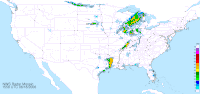
The WSR-88D Doppler atmospheric condition radar organization, also chosen NEXRAD, was developed past the National Weather Service during the mid-1980s, and fully deployed throughout the majority of the United States by 1997. There are 158 such radar sites in operation in the U.Southward., its diverse territorial possessions and selected overseas locations. This engineering, considering of its high resolution and power to detect intra-cloud motions, is now the cornerstone of the agency's severe weather condition warning operations.
National Conditions Service meteorologists utilize an advanced information processing, display and telecommunications organization, the Advance Weather Interactive Processing System (AWIPS), to complete their piece of work. These workstations allow them to easily view a multitude of weather and hydrologic information, besides every bit compose and disseminate products. The NWS Environmental Modeling Heart was one of the early users of the ESMF common modeling infrastructure. The Global Forecast System (GFS) is one of the applications that is congenital on the framework.
In 2016, the NWS significantly increased the computational power of its supercomputers, spending $44 meg on two new supercomputers from Cray and IBM. This was driven past relatively lower accuracy of NWS' Global Forecast Organisation (GFS) numerical conditions prediction model, compared to other global weather models.[45] [46] This was most notable in the GFS model incorrectly predicting Hurricane Sandy turning out to sea until four days earlier landfall; while the European Center for Medium-Range Weather Forecasts' model predicted landfall correctly at seven days. The new supercomputers increased computational processing power from 776 teraflops to five.78 petaflops.[47] [48] [49]
Organisation [edit]

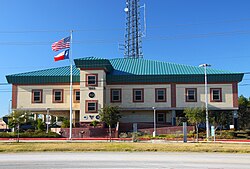
Typical forecast office (WFO)
- National Weather Service (NWS)[51]
- Master Information Officer
- National Centers for Environmental Prediction (NCEP)
- Aviation Weather Center (AWC)
- Climate Prediction Center (CPC)
- Ecology Modeling Middle (EMC)
- Weather Prediction Heart (WPC)
- Ocean Prediction Center (OPC)
- NCEP Central Operations
- Space Atmospheric condition Prediction Center (SWPC)
- Storm Prediction Center (SPC)
- National Hurricane Centre (NHC)
- Hurricane Specialist Unit (HSU)
- Tropical Analysis and Forecast Branch (TAFB)
- Technical Support Co-operative (TSB)
- Primary Fiscal Officeholder
- Operational Systems
- Hydrologic Development
- Science and Technology
- Programs and Plans
- Meteorological Evolution Laboratory (MDL)
- Climate, Water and Weather Services
- automatic atmospheric condition station (AWS)[52]
- 6 Regions (Eastern, Central, Southern, Western, Alaska & Pacific)
- 122 Atmospheric condition Forecast Offices (WFOs)
- 21 Center Atmospheric condition Service Units (CWSU)
- 13 River Forecast Centers (RFC)
- Pacific Tsunami Warning Middle (PTWC)
- National Tsunami Warning Eye (NTWC)
- Spaceflight Meteorology Group (SMG)
Accurateness issues [edit]
Critics such equally University of Washington professor Cliff Mass[53] have pointed out that NWS forecasts are not equally accurate as they could exist, and that this has resulted in inaccurate daily weather forecasts and dangerously bad predictions concerning the location and intensity of extreme weather events like blizzards and hurricanes. Certain private companies, the British Met Office, the European Eye for Medium-Range Weather Forecasts (ECMWF), and the Northwest Regional Modeling Consortium in Seattle take been cited as producing more accurate predictions in certain circumstances. According to critics, causes include:[54]
- Lack of sufficient computing ability to run simulations known to be better (including higher-resolution simulations and "ensemble" forecasts where multiple runs tweak variables slightly to detect low-confidence simulations)
- Non using techniques shown to better accuracy by recent bookish inquiry
- Non assimilating data from all available sources, such as TAMDAR data from commercial airliners. (Due to budget cuts, this could not exist purchased from Panasonic Conditions Solutions on an ongoing basis.)
- Lack of updated equipment on weather satellites
- Lack of focus on a pocket-sized number of high-quality models compared to the Met Function and the ECMWF Integrated Forecast Organization
- Organizational stovepiping and turf wars
- Resistance to change by powerful employee unions
The Side by side Generation Global Prediction Organization project at NWS aims to address some of these criticisms by running a unified high-quality model that takes reward of more contempo research results.[55]
Privatization and dismantling attempts [edit]
While respected as one of the premier conditions organizations in the globe, the National Atmospheric condition Service has been perceived by some conservatives as competing unfairly with the individual sector.[56] National Atmospheric condition Service forecasts and data, being works of the federal regime, are in the public domain and thus available to anyone for free in accordance with U.s. law. From fourth dimension to time, the situation receives official review to define if a bacteria, more efficient approach may be had by some degree of privatization.[ citation needed ]
Aborted Byrne proposal [edit]
In 1983, the Reagan assistants and NOAA administrator John 5. Byrne announced a proposal to sell all of the bureau's atmospheric condition satellites at auction with the intent to repurchase the weather condition data from private contractors that would learn the satellites. Nether the proposal, 30% of NOAA's workforce would be reviewed for potential layoffs, and sure specialty forecasts of agricultural and economical importance would be eliminated. NOAA also proposed outsourcing of weather condition observation stations, NOAA Weather Radio and computerized surface analysis to individual companies. The proposal was met with negative reaction among the public, members of Congress and consumer advocacy groups (including most notably, Ralph Nader), objecting to the possibility of weather condition data intended for the public domain being sold to individual entities that would profit from the sale of the information. The proposal to sell the satellite network failed in a Congressional vote, while other aspects of the proposal to dismantle portions of NOAA'southward agencies were eventually scuttled.[57]
Failed Santorum proposal [edit]
In 2005, Pennsylvania Senator Rick Santorum introduced the National Atmospheric condition Service Duties Human activity of 2005,[58] a bill which would take prohibited the NWS from freely distributing weather information. The nib was widely criticized by users of the NWS'due south services, especially by emergency management officials who rely on the National Weather Service for information during situations such as fires, flooding, or severe weather. Groups such as the Shipping Owners and Pilots Association condemned the bill's restrictions on weather forecasting as threatening the rubber of air traffic, noting that 40% of all aviation accidents are at least partially weather-related.[59] The neb attracted no cosponsors, and died in committee during the 2005 Congressional session.
See as well [edit]
- Reginald Fessenden – known for proving the practicality of using a network of coastal radio stations to transmit weather information
- Meteorological Service of Canada – a Canadian weather forecasting agency operated under Environs Canada, founded in 1876
- NOAA's Environmental Real-time Ascertainment Network
- Radar Operations Heart
References [edit]
- ^ "History of the National Conditions Service". National Weather condition Service . Retrieved July 2, 2016.
- ^ "Guide to Federal Records: Records of the Weather Bureau". National Archives and Records Administration. Retrieved May 23, 2014.
- ^ "Well-nigh NOAA'south National Conditions Service".
- ^ "Final FY21 Appropriations: National Oceanic and Atmospheric Administration". www.aip.org. January 27, 2021. Retrieved March 2, 2021.
- ^ "Argent Jump CDP, Maryland". U.Due south. Census Bureau. Archived from the original on June 7, 2011. Retrieved Baronial two, 2009.
- ^ "NOAA'southward National Weather Service". National Weather Service. Retrieved August 2, 2009.
- ^ Nass, Sharyl J.; Stillman, Bruce, eds. (2003). Large-scale Biomedical Science: Exploring Strategies for Future Enquiry. National Academies Press. p. 224. doi:10.17226/10718. ISBN978-0-309-08912-viii. LCCN 2003009162.
- ^ a b "NWS History". National Conditions Service. Archived from the original on October 13, 2004. Retrieved September xx, 2011.
- ^ Bradford, Marlene (2001). "Tornado Forecasting to 1940". Scanning the Skies: A History of Tornado Forecasting. University of Oklahoma Press. p. 34. ISBN978-0-8061-3302-seven. LCCN 00059979.
- ^ Mathis, Nancy (2007). "A Tornado Forecast". Storm Warning: The Story of a Killer Tornado. Touchstone. pp. 46–fifty. ISBN978-0-7432-8053-ii. LCCN 2006051237.
- ^ Mathis, Nancy (2007). "A Tornado Forecast". Storm Warning: The Story of a Killer Tornado. Touchstone. p. 51. ISBN978-0-7432-8053-2. LCCN 2006051237.
- ^ a b Mathis, Nancy (2007). "A Tornado Forecast". Storm Alert: The Story of a Killer Tornado. Touchstone. pp. 47–53. ISBN978-0-7432-8053-two. LCCN 2006051237.
- ^ The states National Research Quango (1995). "Electric current Roles and Missions". Aviation Weather Services: A Telephone call For Federal Leadership and Action. National Academies Press. p. eighteen. doi:10.17226/5037. hdl:2027/ien.35556021395504. ISBN978-0-309-05380-8. LCCN 95072006.
- ^ Edwards, Roger. "The Online Tornado FAQ". Storm Prediction Center. Archived from the original on March 26, 2018. Retrieved July 6, 2009.
- ^ Mathis, Nancy (2007). "Priority One". Storm Alarm: The Story of a Killer Tornado. Touchstone. p. 86. ISBN978-0-7432-8053-2. LCCN 2006051237.
- ^ Crum, Timothy D.; Alberty, Ron L. (September 1993). "The WSR-88D and the WSR-88D Operational Support Facility". Bulletin of the American Meteorological Society. 74 (9): 1669–87. Bibcode:1993BAMS...74.1669C. doi:10.1175/1520-0477(1993)074<1669:twatwo>2.0.co;2.
- ^ Mathis, Nancy (2007). "Priority One". Tempest Alert: The Story of a Killer Tornado. Touchstone. pp. 92–94. ISBN978-0-7432-8053-2. LCCN 2006051237.
- ^ "NWS Strategic Plan PDF Overview" (PDF). NWS Strategic Program – 2011. National Weather Service. Archived from the original (PDF) on April 25, 2012. Retrieved December eleven, 2012.
- ^ "NDFD Home Page". National Digital Forecast Database. National Weather Service. Nov 8, 2008. Archived from the original on Dec 16, 2008. Retrieved December nineteen, 2008.
- ^ "NDFD Database Contents". National Digital Forecast Database. National Weather Service. Archived from the original on July 31, 2004. Retrieved December 11, 2012.
- ^ "National Fire Danger Rating Organization". NWS Western Region Headquarters. National Oceanic and Atmospheric Administration.
- ^ a b "SPC and its Products". Tempest Prediction Center. National Oceanic and Atmospheric Administration. Retrieved February 22, 2013.
- ^ a b "NWS Flagstaff". NWS Western Region Headquarters. National Oceanic and Atmospheric Administration. Retrieved February 22, 2013.
- ^ "AWC – Aviation Weather Center". National Weather Service. Retrieved December 11, 2012.
- ^ "AWC – Center Conditions Service Unit of measurement Products (CWA, MIS)". Aviation Weather Middle. National Weather Service. Archived from the original on December 26, 2012. Retrieved Dec 11, 2012.
- ^ "About the HPC". Hydrometeorological Prediction Center . Retrieved September 3, 2008.
- ^ "Nigh AHPS". National Weather condition Service. Retrieved December 19, 2008.
- ^ "History of OHRFC". National Weather Service. Archived from the original on January 24, 2003. Retrieved Feb 26, 2012.
- ^ "Bounding main Prediction Centre". National Centers for Environmental Prediction. National Conditions Service. Archived from the original on Oct 6, 2007. Retrieved December 15, 2012.
- ^ "IMDaws" (PDF). www.imdaws.com . Retrieved Feb seven, 2022.
- ^ "NWS ASOS Program". National Weather Service. Retrieved December 19, 2008.
- ^ "Moored Buoy Program". National Data Buoy Center. National Oceanic and Atmospheric Administration. February four, 2008. Archived from the original on Jan three, 2011. Retrieved January 29, 2011.
- ^ "The WMO Voluntary Observing Ships (VOS) Scheme". National Data Buoy Middle. National Oceanic and Atmospheric Assistants. January 28, 2009. Retrieved March 18, 2011.
- ^ "National Weather Service Glossary: West". National Weather Service. National Oceanic and Atmospheric Administration. Retrieved May 26, 2017.
- ^ "National Weather condition Service Glossary: A". National Weather Service. National Oceanic and Atmospheric Administration. Retrieved May 26, 2017.
- ^ "Watch vs. Warning: What'due south the Difference". WeatherWorks. June half-dozen, 2016.
- ^ "NWS Dissemination Services". NWS Office of Climate, Water, and Conditions Services. National Oceanic and Atmospheric Administration. Archived from the original on December 12, 2012. Retrieved January 10, 2010.
- ^ "Impact Based Warnings". National Conditions Service. National Oceanic and Atmospheric Administration. Retrieved March 12, 2014.
- ^ "NWS Expirements" (PDF). National Weather Service. National Oceanic and Atmospheric Administration. Archived from the original (PDF) on April 13, 2012. Retrieved April 15, 2012.
- ^ y Jillian MacMath (April v, 2012). "'CATASTROPHIC': Experimental Tornado Warnings to exist Explicit". AccuWeather. AccuWeather Inc. Archived from the original on Apr four, 2012. Retrieved May 26, 2017.
- ^ Nick Luchetti (April fifteen, 2013). "National Weather condition Service introduces impact-based warnings for tornadoes". Globe Magazine. American Geosciences Institute. Retrieved May 26, 2017.
- ^ a b c "Storm Prediction Center Frequently Asked Questions (FAQ)". National Oceanic and Atmospheric Administration. April 18, 2004. Retrieved May 26, 2017.
- ^ "Storm-Based Warnings: Why Storm-Based Warnings?". NOAA Alert Decision Training Branch. National Oceanic and Atmospheric Administration. February 26, 2008. Archived from the original on January 24, 2010. Retrieved January 11, 2010.
- ^ "Experimental Astringent Conditions Bear upon Graphics" (PDF). National Weather condition Service. Archived from the original (PDF) on Feb 8, 2017. Retrieved May 26, 2017.
- ^ Berger, Eric (June 21, 2016). "The Usa conditions model is at present the fourth best in the world". Ars Technica.
- ^ Berger, Eric (March 11, 2016). "The European forecast model already boot America's butt just improved". Ars Technica . Retrieved August 16, 2016.
- ^ Kravets, David (January v, 2015). "National Weather Service will boost its supercomputing capacity tenfold". Ars Technica . Retrieved August xvi, 2016.
- ^ Rice, Doyle (February 22, 2016). "Supercomputer quietly puts U.S. conditions resources back on tiptop". USA Today . Retrieved August sixteen, 2016.
- ^ "NOAA completes weather and climate supercomputer upgrades". NOAA. Archived from the original on January fourteen, 2016. Retrieved August 16, 2016.
- ^ Kevin Moran (May 23, 2005). "Emergency center now ready to weather storm / The high-tech facility is built higher, stronger". Houston Chronicle. Hearst Corporation. Retrieved January two, 2010.
- ^ "Organization - NOAA'southward National Weather Service". Nws.noaa.gov. September 19, 2016. Retrieved September 24, 2018.
- ^ "IMDaws" (PDF). www.imdaws.com . Retrieved February 12, 2022.
- ^ "Cliff Mass Atmospheric condition and Climate Weblog". Cliffmass.blogspot.com. September 19, 2018. Retrieved September 24, 2018.
- ^ Michael Behar (October 17, 2016). "Why Isn't the U.S. Better at Predicting Extreme Weather?". New York Times Magazine.
- ^ "Side by side Generation Global Prediction Arrangement (NGGPS)". March 17, 2017.
- ^ J. Gratz. "Taking the Initiative: Public/Individual Weather Debate Continues…". University of Colorado. Archived from the original on September 7, 2005.
- ^ Nancy Mathis (2007). Storm Alert: The Story of a Killer Tornado. Touchstone. pp. 90–91. ISBN978-0-7432-8053-two.
- ^ "S.786 – National Weather Services Duties Human action of 2005". Library of Congress. Archived from the original on August 6, 2013.
- ^ "Air Traffic Services Brief – National Weather Service Duties Act of 2005 – Santorum Bill S. 786". AOPA. Apr 28, 2005.
External links [edit]
- Official website

- National Weather condition Service Employees Organization (NWSEO)
Source: https://en.wikipedia.org/wiki/National_Weather_Service
0 Response to "The Best Nws Media House in South Africa Now"
Post a Comment